Imagine an engineer that was assigned the most difficult design problem in human history. They are tasked with building a navigation system that works in complete darkness. It must detect objects smaller than a millimeter, update in real time, weigh almost nothing, run on minimal energy, and repair itself when damaged. Human beings could spend billions trying to solve that problem. Millions, even Billions, spent on research and development alone to simply conceptualize such a state-in-the-art navigation system with these stated features. Then, someone points to a bat. Lo and behold, the solution already exists. And this solution existed since the onset of creation itself — way before this engineer was tasked with this problem.
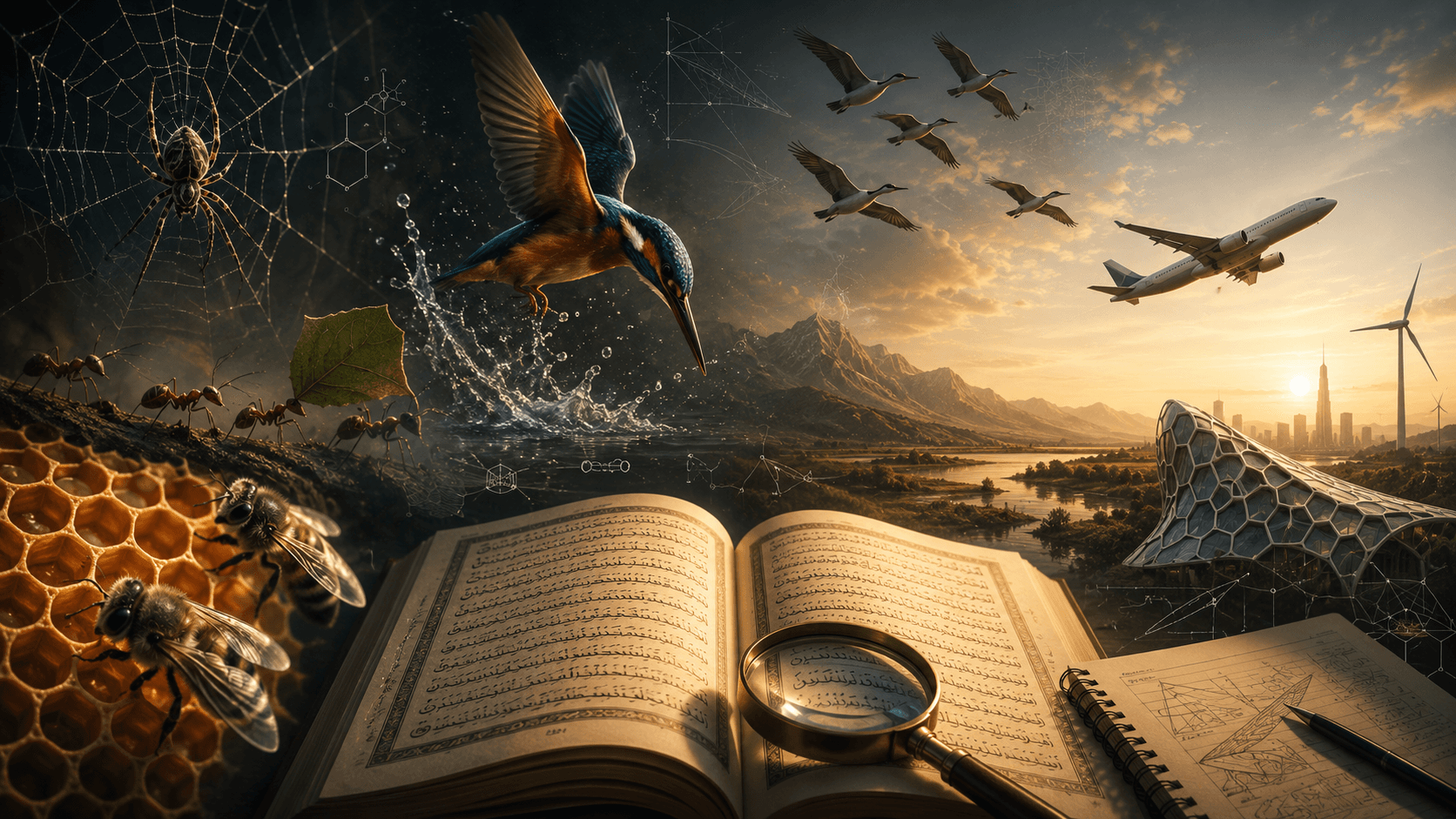
That is the essence of Biomimicry. It’s the practice of studying the natural world to solve human problems. Engineers study birds to improve aircraft. They study bees to build stronger structures. They study ants to improve routing algorithms. They study spiders to design stronger materials. They study camels to improve desert architecture and water conservation. But for the believer, biomimicry is more than science. It’s a form of reading.
The Quran repeatedly commands human beings to look at creation, reflect on it, and recognize the signs of God within it. The natural world is not silent matter. It is filled with āyāt — signs. The same word used for the verses of scripture is also used for the signs in creation. God gave humanity revelation in words, and He placed signs throughout creation. Both point back to the same Author. The question is whether we are actually looking. God says:
In the creation of the heavens and the earth, and the alternation of night and day, there are signs for those who possess intelligence. (3:190)
The people of intelligence are not just those who simply memorize information. They are those who observe reality and recognize meaning in it. The next verse describes them as people who remember God while standing, sitting, and lying down, and who reflect on the creation of the heavens and the earth. Their reflection leads them to say:
“Our Lord, You did not create all this in vain” (3:191).
This is the Quranic model of observation. It’s to understand that when God created creation, He quite literally encoded the solutions to our problems before they became problems. To observe these signs God placed in nature isn’t just to have a sense of detached curiosity, but to understand that God created creation with distinct purposes in mind — the one who possesses knowledge know this, and some even go beyond in attempts to discover these purposes. Elsewhere, God commands:
Say, "Roam the earth and find out the origin of life."± For GOD will thus initiate the creation in the Hereafter. GOD is Omnipotent. (29:20)
Say, "Look at all the signs in the heavens and the earth." All the proofs and all the warnings can never help people who decided to disbelieve. (10:101)
He committed in your service everything in the heavens and the earth; all from Him. These are proofs for people who reflect. (45:13)
God’s creation isn’t just background scenery for individuals to glance at. It’s quite literally a field of signs. To ignore it is to leave a revelation unread.
The Bee and the Geometry of Inspiration
One of the clearest examples comes from the bee. God says:
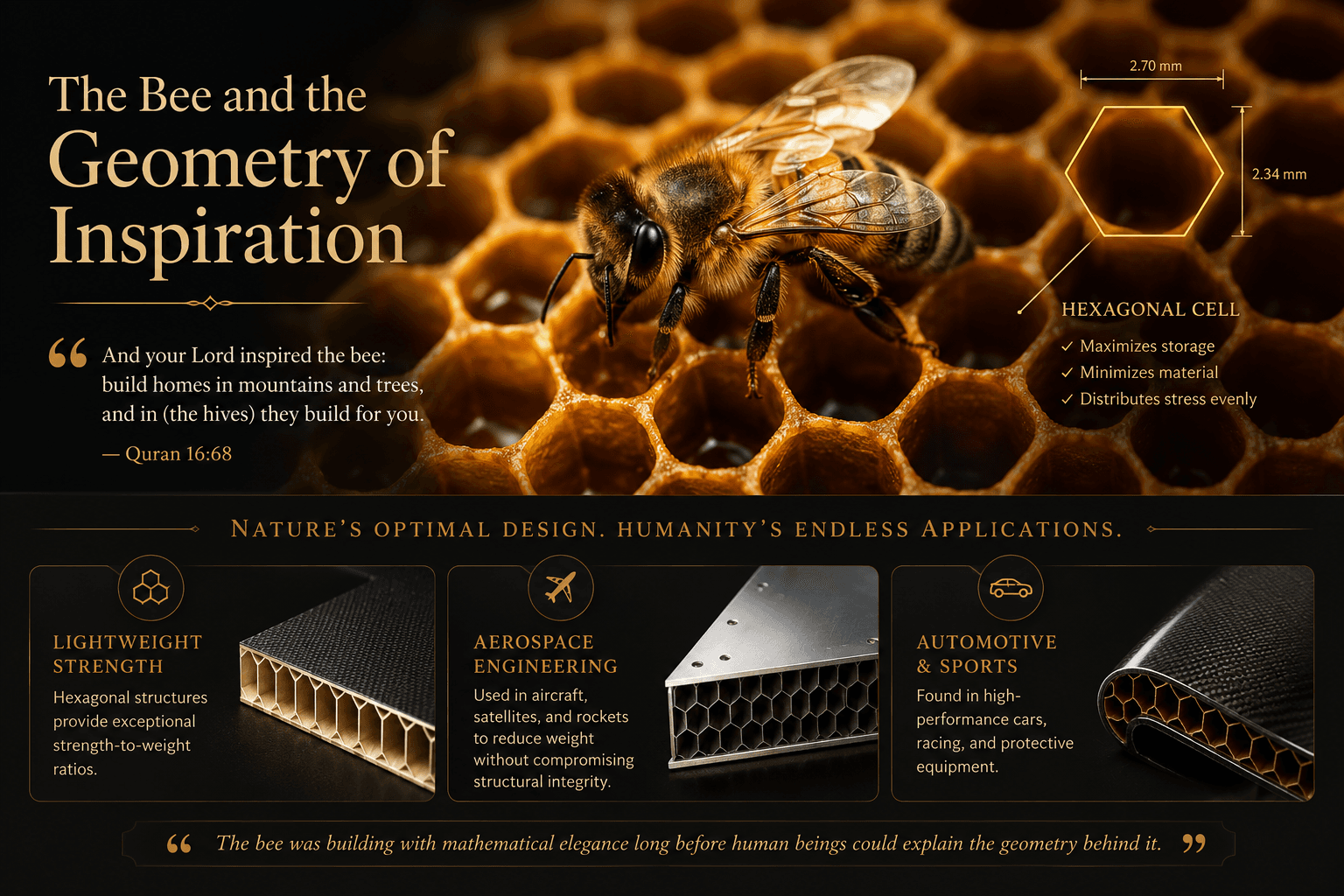
And your Lord inspired the bee: build homes in mountains and trees, and in (the hives) they build for you. (16:68)
The bee’s honeycomb is one of the most efficient structures in the natural world. Hexagons tile space without gaps, distribute stress evenly, and use minimal material for maximum volume. Human engineers use honeycomb structures in aircraft, satellites, cars, architecture, and protective materials. We call this innovative genius, but God quite literally calls this inspiration. The bee was building with mathematical elegance long before human beings could explain the geometry behind it.
Birds and the Science of Flight
The Quran repeatedly points to birds:
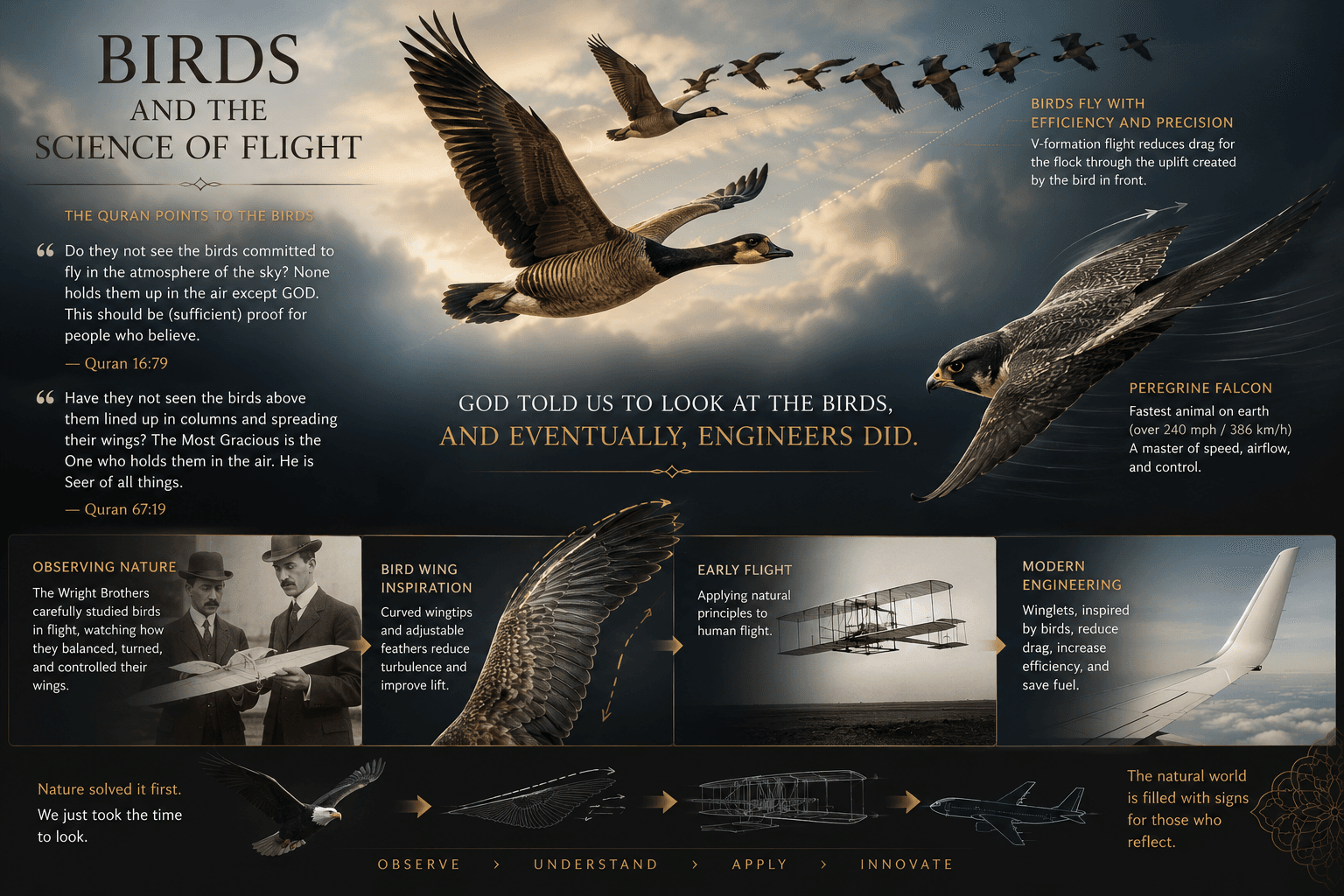
Do they not see the birds committed to fly in the atmosphere of the sky? None holds them up in the air except GOD. This should be (sufficient) proof for people who believe. (16:79)
Have they not seen the birds above them lined up in columns and spreading their wings? The Most Gracious is the One who holds them in the air. He is Seer of all things. (67:19)
Human flight developed by studying birds. The Wright Brothers observed how birds controlled their wings. Modern aircraft winglets imitate the curled feathers of soaring birds, reducing drag and saving fuel. Even high-speed aerodynamics continues to learn from birds of prey. The peregrine falcon, the fastest animal on earth, solved problems of speed, airflow, and control long before human aerospace engineering existed. God told us to look at the birds, and eventually, engineers did.
The Kingfisher and the Bullet Train
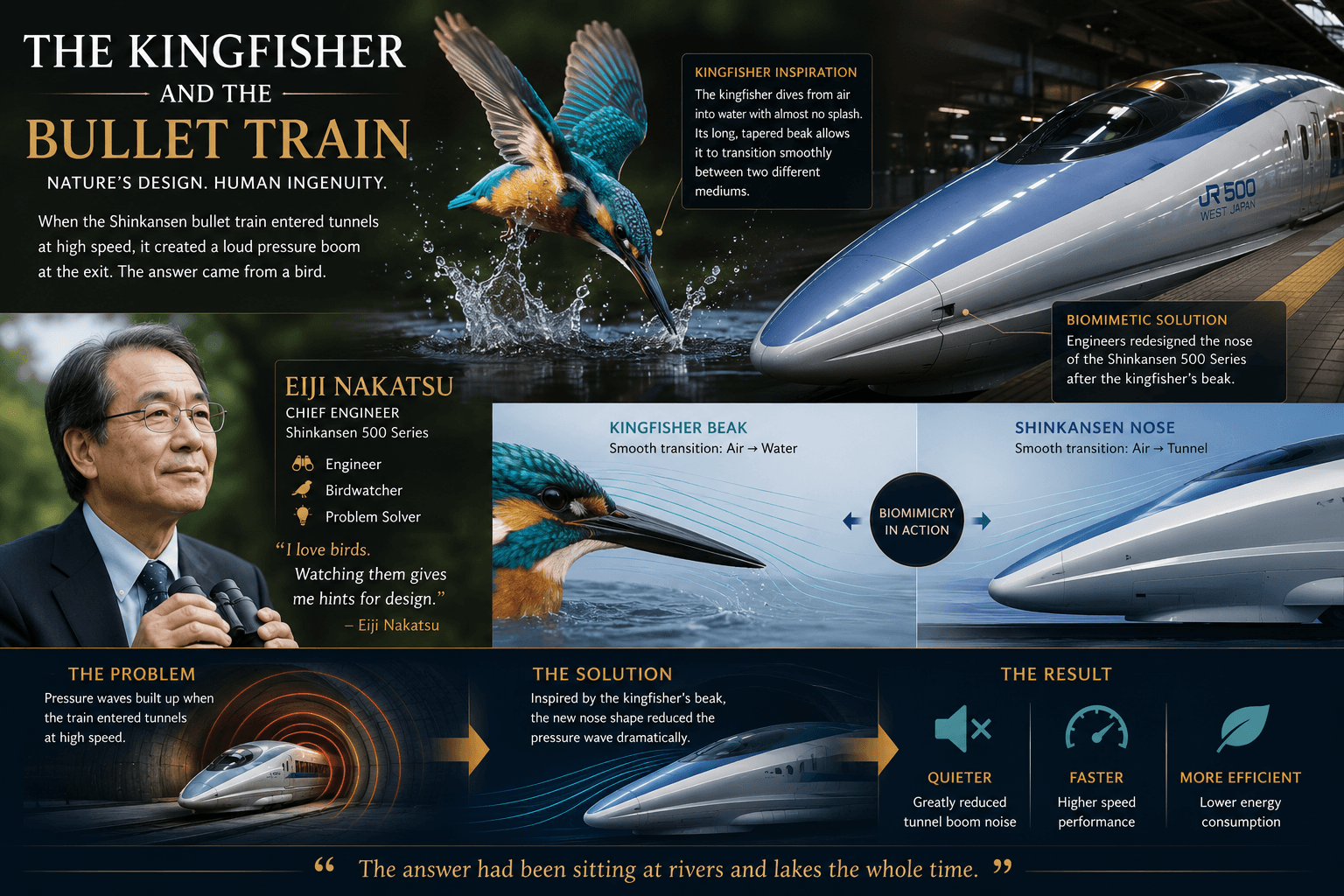
One of the most famous examples of biomimicry is the Japanese Shinkansen bullet train. The train had a problem. When it entered tunnels at high speed, it produced a loud pressure boom at the exit. The solution came from the kingfisher. The kingfisher dives from air into water with almost no splash. Its long, tapered beak allows it to transition between two very different mediums smoothly. Engineers redesigned the train’s nose after the kingfisher’s beak. The result was a quieter, faster, and more energy-efficient train .The answer had been sitting at rivers and lakes the whole time.
The Spider and the Strength of Fragility
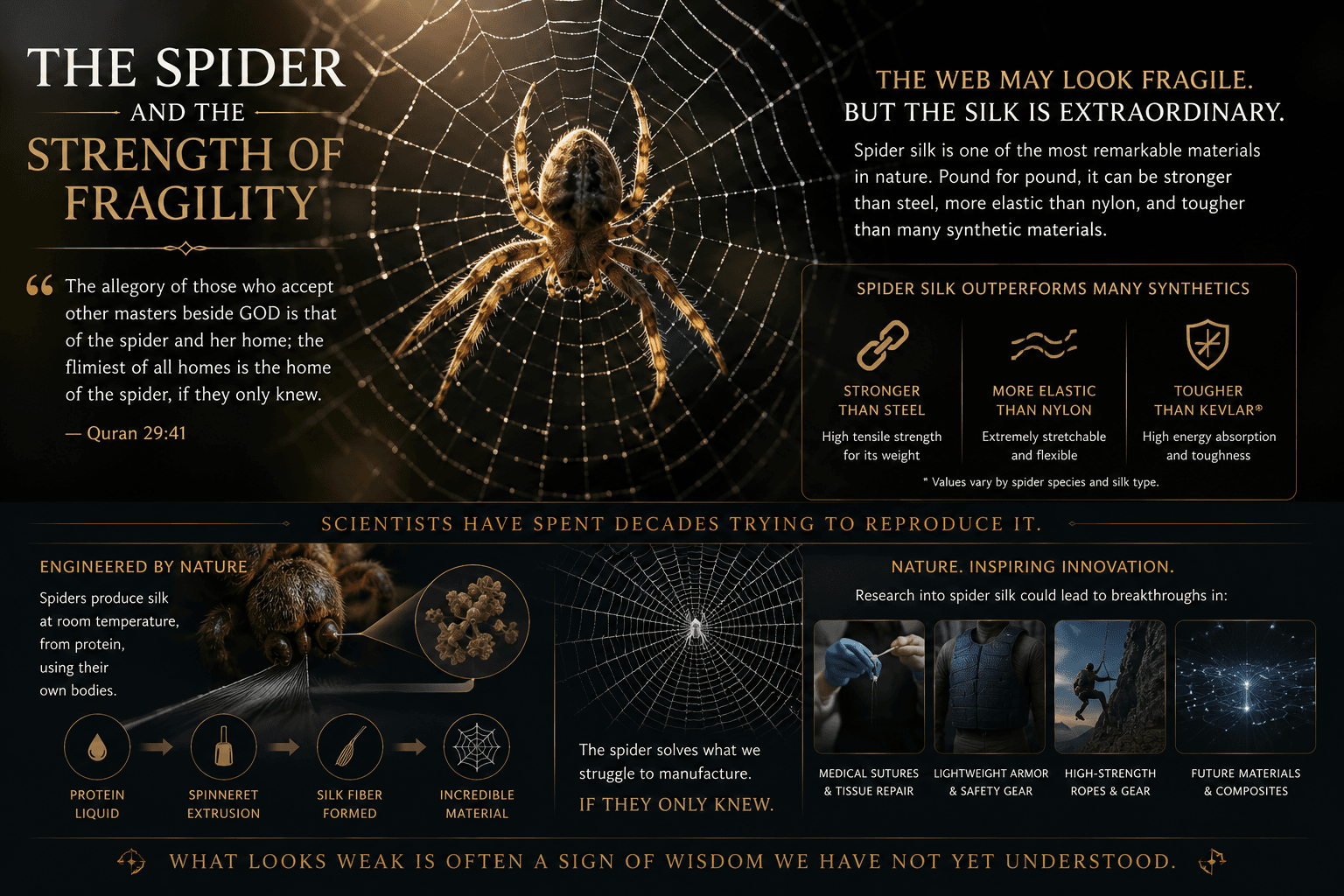
“The allegory of those who accept other masters beside GOD is that of the spider and her home; the flimsiest of all homes is the home of the spider, if they only knew.” (29:41)
The spider’s web may look fragile, but spider silk is one of the most remarkable materials in nature. Pound for pound, it can be stronger than steel, more elastic than nylon, and tougher than many synthetic materials. Scientists have spent decades trying to reproduce it. The spider produces it at room temperature, from protein, using its own body. What we struggle to manufacture, the spider produces naturally. “If they only knew.”
The Ant and Collective Intelligence
In Sura 27, the Quran presents an ant warning its colony about Solomon and his soldiers:
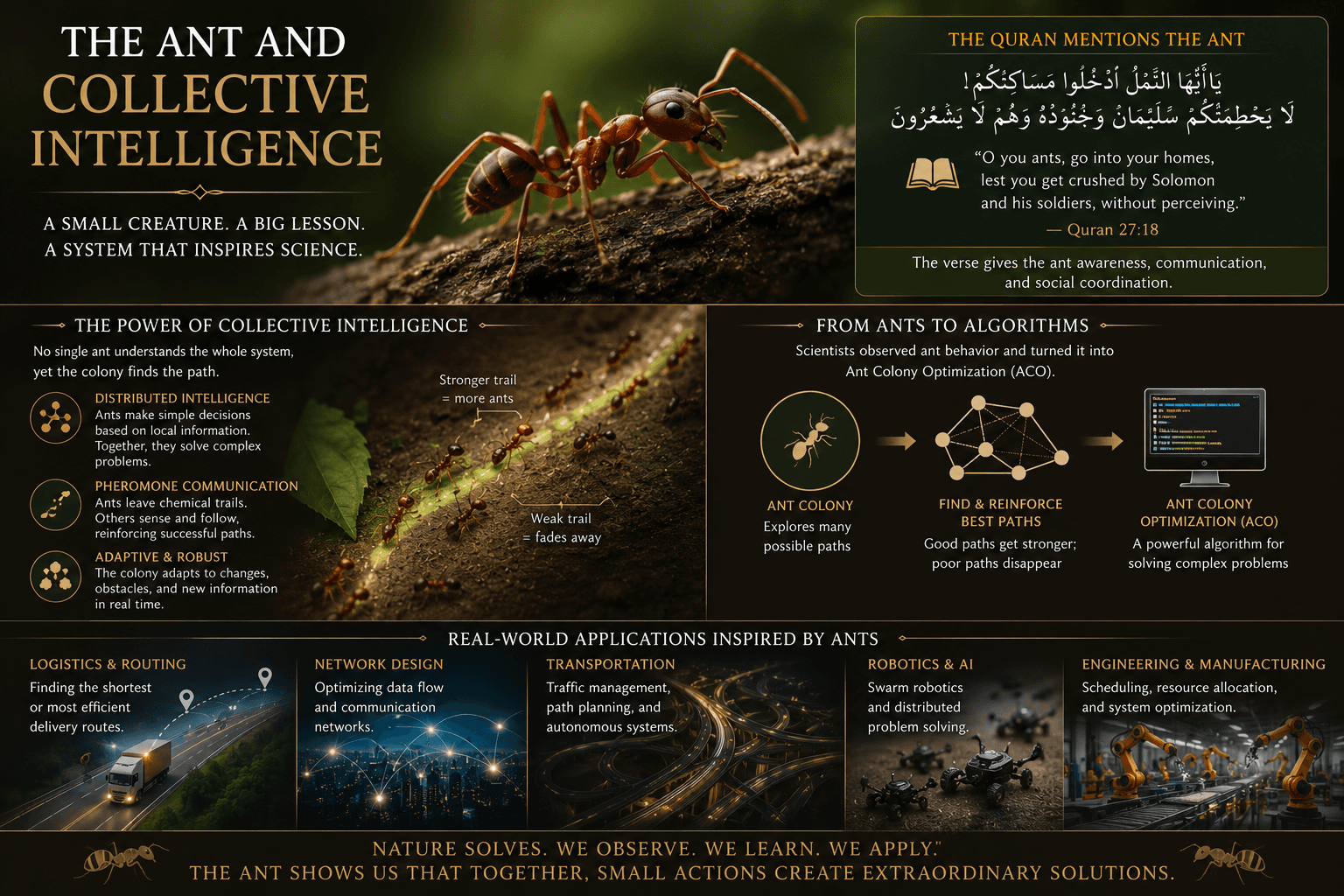
“O you ants, go into your homes, lest you get crushed by Solomon and his soldiers, without perceiving.” (27:18)
The verse gives the ant awareness, communication, and social coordination. Modern science has shown that ant colonies solve complex problems through distributed intelligence. Ants use pheromone trails to find efficient routes, and this inspired Ant Colony Optimization algorithms used in logistics, routing, and network systems. No single ant understands the whole system, yet the colony finds the path. Human engineers later turned this into computation.
The Signs Within Ourselves
“We will show them our proofs in the horizons, and within themselves, until they realize that this is the truth.” (41:53)
The signs are not only outside us. They are also within us. Consider the human ear. For years, hearing aids treated hearing loss as a simple amplification problem. Make sounds louder, and people should hear better. But the ear is not merely an amplifier. The outer ear shapes sound before it enters the ear canal. The bones of the middle ear form a delicate mechanical system. The cochlea translates vibration into neural information with extraordinary precision. When engineers began designing devices that worked with the ear’s natural system rather than bypassing it, the technology improved. The body itself is a book of signs.
The bat was navigating in darkness long before sonar technology. The kingfisher was solving pressure problems long before bullet trains. The signs were not hidden. The problem was our attention. The Quran’s criticism is not that creation lacks evidence, it’s criticism is that human beings pass by these signs without actually seeing them. Biomimicry reminds us that creation is not random scenery. It’s instruction. The natural world contains solutions, patterns, efficiencies, and designs that human beings are still struggling to understand. Again and again, engineers discover that living systems contain answers more elegant than what we produced on our own. For the Submitter, this should deepen faith. Not because we need fragile scientific miracle claims, but because the Quran already told us what to do. The signs are in the horizons, and within ourselves. All we need to do is look.